
1. What Is ServiceNow Event Management?
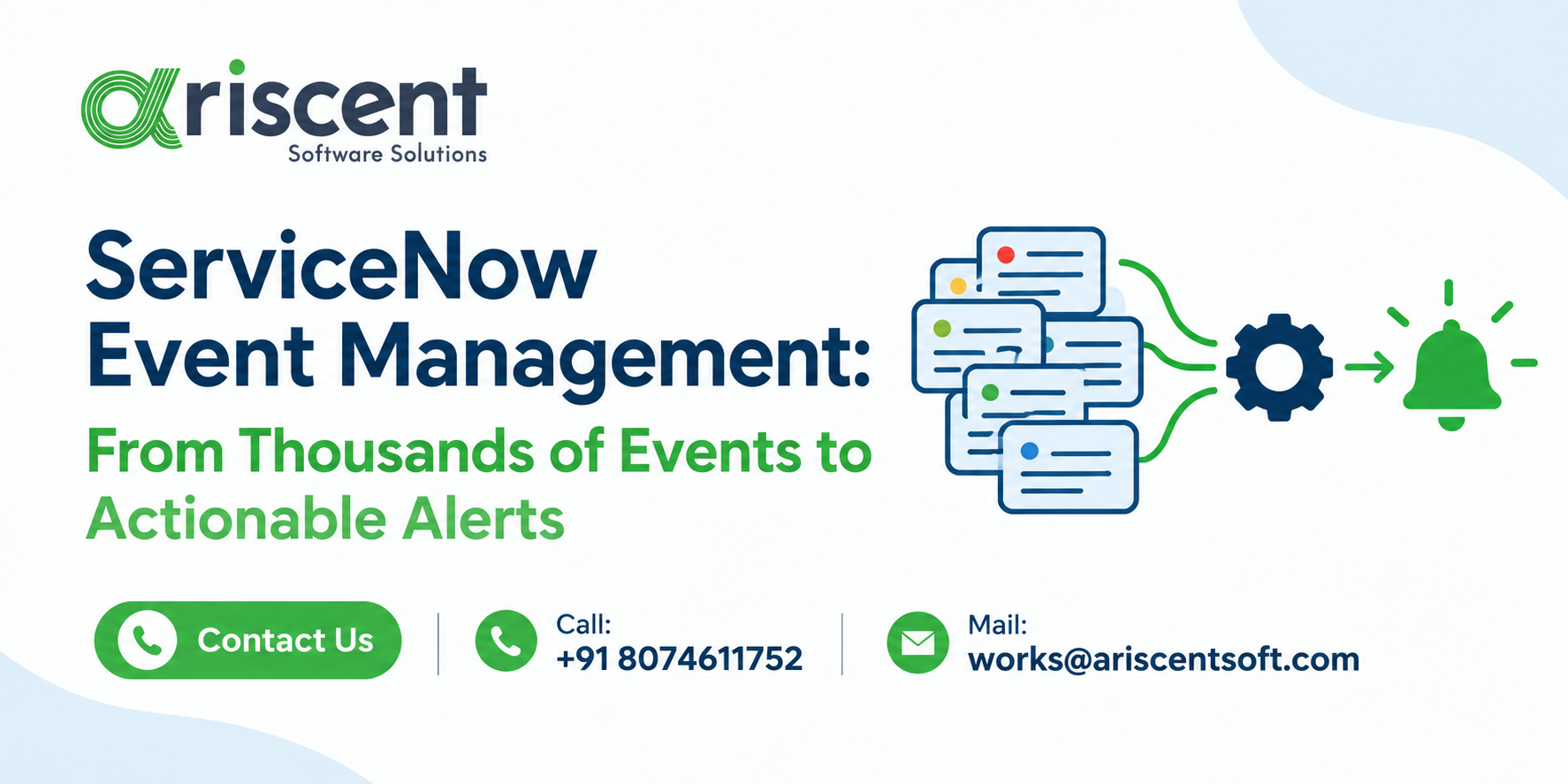
ServiceNow Event Management is a key capability of ServiceNow ITOM that helps organizations monitor, identify, and manage events generated by IT infrastructure, applications, cloud platforms, and monitoring tools. Instead of allowing thousands of events to overwhelm IT teams, Event Management analyzes incoming data, filters unnecessary noise, and converts relevant events into actionable alerts. These alerts can then trigger automated workflows and incidents for faster resolution. With the right ServiceNow Consulting approach, organizations can configure event rules, alert correlation, integrations, and automated responses according to their operational needs. A successful ServiceNow Implementation helps businesses create a proactive monitoring environment, reduce alert fatigue, improve incident response, and increase overall IT visibility. This enables IT teams to focus on critical issues while automation handles repetitive monitoring tasks.
2. Why Enterprises Struggle with Thousands of IT Events
Modern enterprises manage complex IT environments that generate thousands of events from servers, applications, networks, cloud platforms, and monitoring tools. Without effective ServiceNow Event Management, IT teams can quickly become overwhelmed by duplicate, irrelevant, or low-priority events. This creates alert fatigue, making it difficult to identify genuine incidents that require immediate attention. Traditional monitoring approaches may also lack centralized visibility, resulting in slower troubleshooting and increased downtime. By integrating ServiceNow ITSM with ServiceNow ITOM, organizations can connect event monitoring with incident management and operational workflows. ServiceNow helps filter event noise, correlate related alerts, prioritize critical issues, and automate incident creation. This allows IT teams to focus on business-impacting problems while improving response times, operational visibility, and overall service reliability.
3. How ServiceNow Event Management Reduces Event Noise
ServiceNow Event Management helps enterprises manage large volumes of IT events by filtering unnecessary alerts and identifying issues that require attention. Events collected from servers, networks, applications, cloud platforms, and monitoring tools can be analyzed using event rules, thresholds, and alert correlation. Duplicate or low-value events can be suppressed, while related events can be grouped into a single actionable alert. This significantly reduces alert fatigue and allows IT teams to focus on business-critical issues. With ServiceNow Managed Services, organizations can continuously monitor, fine-tune event rules, and maintain effective alert management as their IT environment changes. ServiceNow Integration Services can also connect monitoring platforms with ServiceNow, enabling seamless event ingestion, automated alert processing, and faster incident response across the enterprise.
4. From Raw Events to Actionable Alerts: How It Works
ServiceNow Event Management transforms large volumes of raw IT events into meaningful, actionable alerts. Events generated by servers, networks, applications, cloud environments, and monitoring tools are first collected and processed within the ServiceNow platform. Event rules then evaluate incoming data based on conditions such as severity, source, and event type. Unnecessary or duplicate events can be filtered out, while related events are correlated to reduce alert noise. Important events are converted into alerts that help IT teams quickly identify potential service disruptions. With ServiceNow Consulting Hyderabad, organizations can design event management strategies aligned with their IT operations and business requirements. A well-planned ServiceNow Implementation Hyderabad enables automated workflows, faster incident response, improved visibility, and proactive IT operations across complex enterprise environments.
5. Understanding Events, Alerts, and Incidents in ServiceNow
ServiceNow Event Management helps IT teams understand and manage issues by connecting events, alerts, and incidents in a structured workflow. An event is raw information generated by monitoring tools, servers, applications, or network devices. When ServiceNow processes an event and determines that it requires attention, it can create an alert containing relevant details such as severity, source, and configuration item. Multiple related events can also be correlated into a single alert to reduce noise. When an alert indicates a business-impacting issue, it can trigger an incident through ITSM workflows for investigation and resolution. With ServiceNow ITSM Hyderabad and ServiceNow ITOM Hyderabad, organizations can improve monitoring, automate incident creation, reduce response times, and gain better visibility into their IT operations.
6. How Event Rules Filter and Prioritize IT Events
ServiceNow Event Management uses event rules to analyze incoming IT events and determine which ones require immediate attention. These rules evaluate information such as event source, severity, priority, and event type to filter unwanted or duplicate events. Relevant events can be transformed into actionable alerts, while unnecessary events can be ignored or suppressed. Event rules also help organizations prioritize critical issues based on their potential impact on business services. This reduces alert noise and allows IT teams to focus on high-priority problems. With ServiceNow Managed Services Hyderabad, businesses can continuously monitor, optimize, and maintain event rules as their IT environment evolves. ServiceNow Integration Services Hyderabad can connect monitoring platforms with ServiceNow, enabling seamless event processing, automated alert handling, and faster incident response across enterprise IT operations.
7. Event Correlation: Turning Multiple Events into One Alert
ServiceNow Event Management uses event correlation to connect multiple related events and identify the underlying issue behind them. In a large IT environment, a single infrastructure problem can generate hundreds of events from servers, applications, networks, and monitoring tools. Without correlation, IT teams may receive numerous alerts for the same issue, creating unnecessary noise and slowing incident response. ServiceNow can analyze event relationships, configuration items, and patterns to group related events into a meaningful alert. This helps teams identify the root cause faster and focus on issues that have real business impact. With ServiceNow Consulting India, organizations can design effective correlation strategies, while ServiceNow Implementation India enables automated alert processing, improved operational visibility, reduced alert fatigue, and faster IT service resolution.
8. How ServiceNow Event Management Improves IT Operations
ServiceNow Event Management helps organizations improve IT operations by providing centralized visibility into events generated across infrastructure, applications, networks, and cloud environments. Instead of manually reviewing thousands of notifications, IT teams can use automated event processing, filtering, and correlation to identify meaningful alerts. This reduces alert fatigue and helps teams respond faster to critical issues. Integration with incident management also enables relevant alerts to trigger incidents automatically, improving resolution workflows and reducing downtime. By combining ServiceNow ITSM India with ServiceNow ITOM India, organizations can connect service management with infrastructure monitoring and gain better operational visibility. Event Management also supports proactive issue detection, faster troubleshooting, improved service availability, and more efficient IT operations, helping enterprises deliver reliable digital services while reducing manual effort and operational complexity.
9. Integrating Monitoring Tools with ServiceNow Event Management
ServiceNow Event Management enables organizations to connect monitoring tools with a centralized IT operations platform. Tools such as SolarWinds, Nagios, Datadog, and other monitoring solutions can send infrastructure and application events to ServiceNow for processing. Incoming events are analyzed using event rules, filters, and correlation techniques to identify important issues and reduce unnecessary alert noise. Relevant alerts can then trigger automated workflows or incidents, helping IT teams respond quickly to potential service disruptions. With ServiceNow Managed Services India, businesses can continuously monitor integrations, optimize event rules, and maintain reliable operations. ServiceNow Integration Services India helps organizations establish secure and efficient connections between monitoring platforms and ServiceNow, enabling centralized visibility, automated alert processing, faster incident response, and improved operational efficiency across complex enterprise environments.
10. ServiceNow Event Management and ITOM: A Powerful Combination
ServiceNow Event Management is an important component of ServiceNow ITOM that helps organizations monitor and manage events across their IT infrastructure. When combined with ITOM capabilities such as Discovery, CMDB, and Service Mapping, Event Management provides better visibility into infrastructure, applications, and business services. It can collect events from monitoring tools, filter unnecessary notifications, correlate related events, and create actionable alerts. This helps IT teams identify potential issues before they significantly impact business services. With ServiceNow Consulting United States, organizations can design an ITOM strategy that aligns monitoring, event management, and operational workflows with business goals. A well-planned ServiceNow Implementation United States enables automation, faster incident response, improved service availability, reduced alert noise, and more efficient management of complex enterprise IT environments.
11. Real-World Example: From Thousands of Events to a Few Actionable Alerts
Consider an enterprise environment where servers, applications, databases, and network devices generate thousands of events every day. Without proper monitoring, IT teams may receive hundreds of duplicate or low-priority notifications, making it difficult to identify critical problems. With ServiceNow Event Management, incoming events can be filtered, grouped, and correlated based on their source, severity, and configuration items. For example, multiple server alerts caused by a single network issue can be correlated into one actionable alert. Through integration with ServiceNow ITSM United States, critical alerts can automatically create incidents and trigger predefined workflows. Combined with ServiceNow ITOM United States, this approach improves infrastructure visibility, reduces alert noise, accelerates root-cause identification, and enables IT teams to focus on business-impacting issues.
12. Conclusion: Turning IT Event Noise into Business Value
Modern IT environments generate a continuous stream of events, making it challenging for teams to identify issues that truly require attention. ServiceNow Event Management helps transform this event noise into meaningful, actionable alerts through intelligent filtering, event correlation, prioritization, and automation. By connecting monitoring tools with ITSM and ITOM workflows, organizations can reduce alert fatigue, improve incident response, and increase operational visibility. The right ServiceNow Consulting approach helps businesses design event management strategies that align with their infrastructure, services, and business objectives. A well-planned ServiceNow Implementation can further automate alert processing, incident creation, and response workflows. Ultimately, ServiceNow Event Management enables organizations to move from reactive monitoring to proactive IT operations, improving service reliability, reducing downtime, and delivering greater business value from IT operations.