
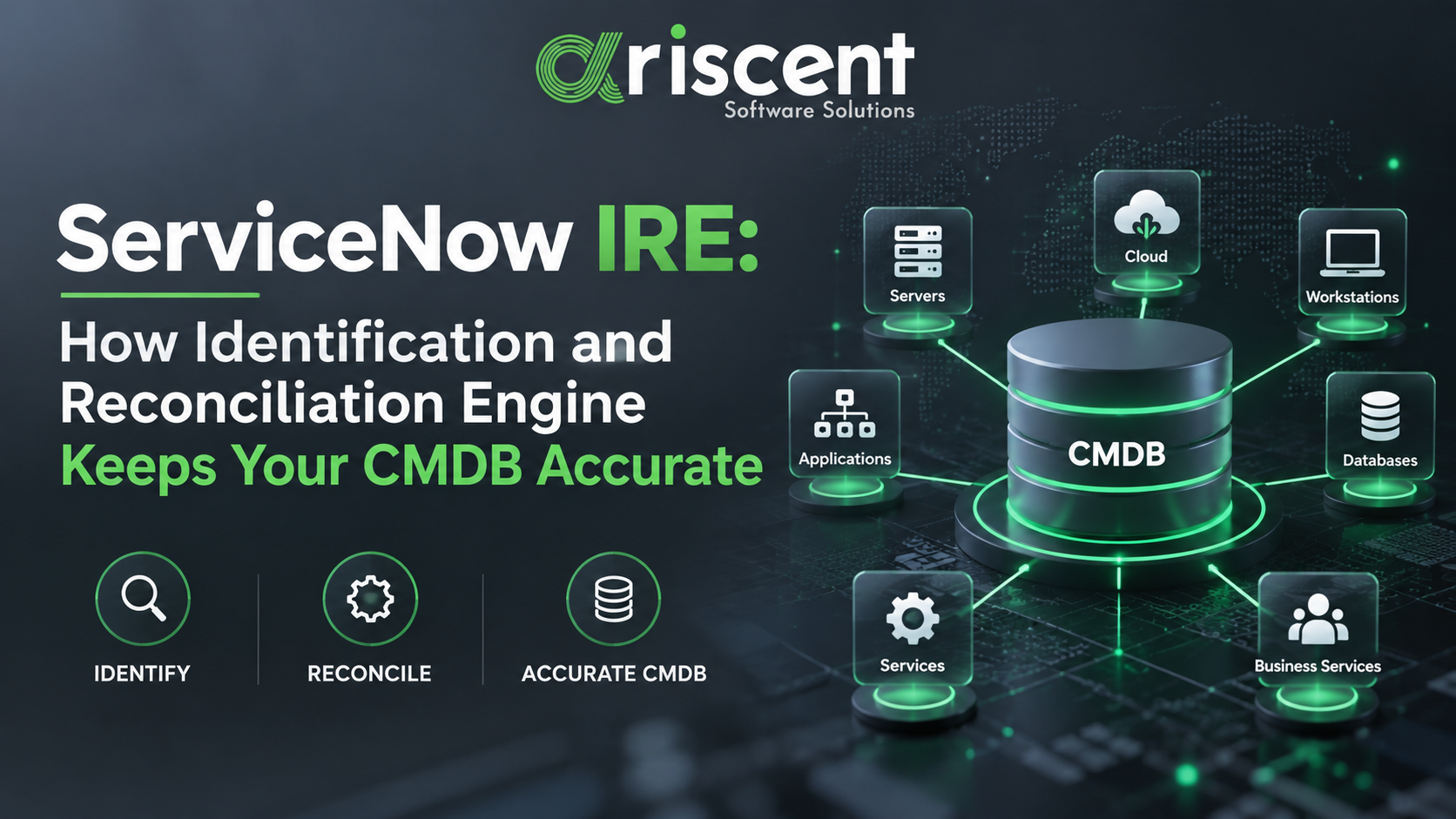
1. ServiceNow IRE Explained: A Guide to Accurate CMDB Data
ServiceNow IRE plays a critical role in maintaining accurate and reliable Configuration Management Database (CMDB) data. The ServiceNow Identification and Reconciliation Engine helps identify whether incoming data belongs to an existing Configuration Item (CI) or requires the creation of a new CI. The ServiceNow IRE Engine uses identification rules to match incoming information with existing CIs and reconciliation rules to determine which data sources can update specific CI attributes. This helps organizations reduce duplicate records, maintain data consistency, and improve overall CMDB health. IRE can process data from sources such as Discovery, Service Mapping, integrations, and import processes. By establishing proper identification and reconciliation rules, organizations can improve CI relationships, strengthen data integrity, and create a more trustworthy CMDB for ITSM and ITOM operations.
2. How ServiceNow IRE Improves CMDB Accuracy and Data Quality
ServiceNow IRE helps organizations maintain reliable and consistent configuration data within the ServiceNow CMDB. The Identification and Reconciliation Engine evaluates incoming CI information and determines whether it matches an existing configuration item or represents a new CI. This process helps prevent duplicate records and improves ServiceNow CMDB accuracy across different data sources. IRE uses identification rules to match CIs based on defined attributes and reconciliation rules to control which sources can update specific CI fields. This is particularly useful when data comes from Discovery, Service Mapping, integrations, and import processes. By applying consistent identification and reconciliation logic, organizations can improve data integrity, reduce duplicate CIs, and maintain trustworthy infrastructure information. A reliable CMDB also supports better ITSM and ITOM processes, including incident management, change management, impact analysis, and service visibility.
3. ServiceNow IRE: The Key to Accurate and Reliable CMDB Data
ServiceNow IRE plays an important role in maintaining accurate and trustworthy configuration data within the ServiceNow CMDB. The Identification and Reconciliation Engine evaluates incoming CI information and determines whether it matches an existing configuration item or should create a new record. This process supports ServiceNow CMDB data integrity by applying defined identification and reconciliation rules across multiple data sources. Effective ServiceNow CMDB deduplication helps prevent duplicate Configuration Items and ensures that infrastructure data remains consistent. IRE can process information from Discovery, Service Mapping, integrations, and other sources while controlling how CI attributes are updated. By establishing appropriate identification rules, reconciliation rules, and data source priorities, organizations can improve CMDB quality, reduce duplicate records, strengthen relationships between CIs, and provide more reliable data for ITSM and ITOM processes.
4. Understanding ServiceNow IRE: Identification and Reconciliation Explained
ServiceNow IRE helps organizations maintain consistent and trustworthy Configuration Item (CI) information within the CMDB. ServiceNow CI identification determines whether incoming data matches an existing CI or should result in a new record. IRE uses identification rules and specific CI attributes to establish accurate matches and reduce duplicate configuration items. ServiceNow CMDB data reconciliation controls which data sources are authorized to update CI attributes when multiple systems provide information about the same CI. This helps maintain data ownership and prevent lower-priority sources from overwriting trusted information. By combining identification and reconciliation processes, ServiceNow can improve CMDB data quality, reduce duplicate records, and maintain reliable infrastructure information. This provides a stronger foundation for ITSM, ITOM, Discovery, Service Mapping, incident management, change management, and impact analysis.
5. ServiceNow IRE and CMDB: How to Prevent Duplicate CIs
ServiceNow IRE helps organizations maintain accurate Configuration Items (CIs) and reduce duplicate records within the CMDB. How ServiceNow IRE works depends on identification and reconciliation rules that evaluate incoming CI data from sources such as Discovery, integrations, and import processes. The Identification and Reconciliation Engine compares incoming attributes against existing CMDB records to determine whether the data belongs to an existing CI or represents a new CI. This identification process helps prevent unnecessary duplicate records. Reconciliation rules then control which authorized data sources can update specific CI attributes. Understanding How ServiceNow IRE keeps CMDB accurate helps organizations improve data consistency, strengthen CI relationships, and maintain reliable infrastructure information. Properly configured IRE also supports better Discovery results, CMDB health, ITSM processes, ITOM operations, and impact analysis.
6. How ServiceNow IRE Prevents Duplicate Configuration Items
ServiceNow IRE helps prevent duplicate Configuration Items (CIs) by evaluating incoming data against existing records in the CMDB. ServiceNow IRE identification rules define the attributes that the Identification and Reconciliation Engine uses to determine whether incoming information matches an existing CI or represents a new configuration item. This matching process helps maintain a consistent CMDB and reduces duplicate records from multiple data sources. ServiceNow IRE reconciliation rules control which authorized data sources can update CI attributes when information is received from different systems. Together, identification and reconciliation rules help maintain data consistency, improve CMDB reliability, and support accurate infrastructure visibility. Organizations can use IRE with Discovery, Service Mapping, integrations, and import processes to maintain trustworthy CI information and strengthen ITSM and ITOM processes.
7. ServiceNow IRE: A Complete Guide to CMDB Identification and Reconciliation
ServiceNow IRE helps organizations maintain accurate and consistent Configuration Item (CI) records within the CMDB. The Identification and Reconciliation Engine evaluates incoming CI data to determine whether it matches an existing record or requires a new CI. Understanding How to prevent duplicate CIs in ServiceNow starts with properly configured identification rules that define how CIs are matched using attributes such as hostnames, serial numbers, or other identifiers. Reconciliation rules then control which data sources are permitted to update CI attributes. Following ServiceNow IRE best practices includes defining reliable identification criteria, establishing clear data-source ownership, reviewing duplicate records, and regularly monitoring CMDB data quality. Proper IRE configuration can improve data consistency and provide more reliable infrastructure visibility for ITSM and ITOM processes.
8. ServiceNow IRE Best Practices for Better CMDB Data Quality
ServiceNow IRE helps organizations maintain consistent and reliable Configuration Item (CI) information across the CMDB. ServiceNow CMDB identification and reconciliation processes determine how incoming CI data is matched to existing records and which data sources are allowed to update specific attributes. Following best practices includes defining accurate identification rules, establishing clear data-source ownership, avoiding unnecessary customizations, and regularly reviewing duplicate or incomplete CIs. Organizations should also monitor CMDB health and validate Discovery and integration data to ensure reliable inputs. Effective ServiceNow IRE troubleshooting involves checking identification rules, reconciliation rules, data source priorities, CI attributes, and IRE processing results when unexpected records or updates occur. A well-maintained IRE configuration can reduce duplicate CIs, improve data consistency, and provide a stronger foundation for ITSM, ITOM, Discovery, and Service Mapping.
9. How Identification and Reconciliation Keeps Your ServiceNow CMDB Accurate
ServiceNow IRE helps organizations maintain accurate and consistent Configuration Item (CI) data within the CMDB. The Identification process determines whether incoming data matches an existing CI or represents a new configuration item, helping reduce duplicate records. The Reconciliation process controls which authorized data sources can update specific CI attributes, ensuring that trusted information is maintained across the environment. Effective IRE configuration supports better data consistency, improves CI relationships, and strengthens CMDB data quality. Organizations implementing ServiceNow Consulting services can establish appropriate identification and reconciliation strategies based on their infrastructure and data sources. Through ServiceNow Implementation, organizations can configure CMDB processes, Discovery integrations, data-source ownership, and governance practices to support reliable ITSM and ITOM operations.
10. ServiceNow IRE Architecture: How CI Identification and Reconciliation Work
ServiceNow ITSM and ServiceNow ITOM rely on accurate CMDB data to support effective IT operations and service management. The ServiceNow Identification and Reconciliation Engine (IRE) processes incoming Configuration Item (CI) data and determines whether it matches an existing CI or should create a new record. During identification, IRE evaluates configured attributes and identification rules to find the correct CI. Reconciliation then determines whether the incoming data source is authorized to update specific CI attributes. This architecture helps reduce duplicate CIs, maintain data consistency, and improve CMDB reliability. In ServiceNow ITOM, IRE supports data coming from Discovery, Service Mapping, and integrations, while ServiceNow ITSM can use trusted CMDB information for incident, problem, change, and impact analysis processes.
11. ServiceNow IRE Identification Rules vs Reconciliation Rules Explained
ServiceNow IRE uses identification and reconciliation rules to maintain accurate and consistent Configuration Item (CI) data in the CMDB. Identification rules determine whether incoming CI information matches an existing record or should create a new CI, helping reduce duplicate records. Reconciliation rules determine which authorized data sources can update specific CI attributes when multiple sources provide information about the same configuration item. Understanding the difference between these two processes is important for maintaining CMDB data quality and establishing clear data ownership. ServiceNow Managed Services can help organizations monitor IRE behavior, review CMDB data quality, and troubleshoot identification or reconciliation issues. ServiceNow Integration Services can also help connect external discovery and monitoring systems while ensuring incoming CI data follows appropriate identification and reconciliation rules.
12. ServiceNow IRE: Understanding Identification Rules, Reconciliation Rules and Data So
ServiceNow IRE is an important component for maintaining accurate and consistent Configuration Item (CI) data within the CMDB. Identification rules determine whether incoming CI information matches an existing record or represents a new CI, helping reduce duplicate configuration items. Reconciliation rules control which data sources are authorized to update specific CI attributes when information is received from multiple systems. Data sources such as Discovery, Service Mapping, integrations, and import processes can provide CI information to the CMDB. Organizations using ServiceNow Consulting Hyderabad services can establish appropriate IRE strategies based on their infrastructure and data requirements. Through ServiceNow Implementation Hyderabad, businesses can configure identification rules, reconciliation rules, Discovery integrations, an