
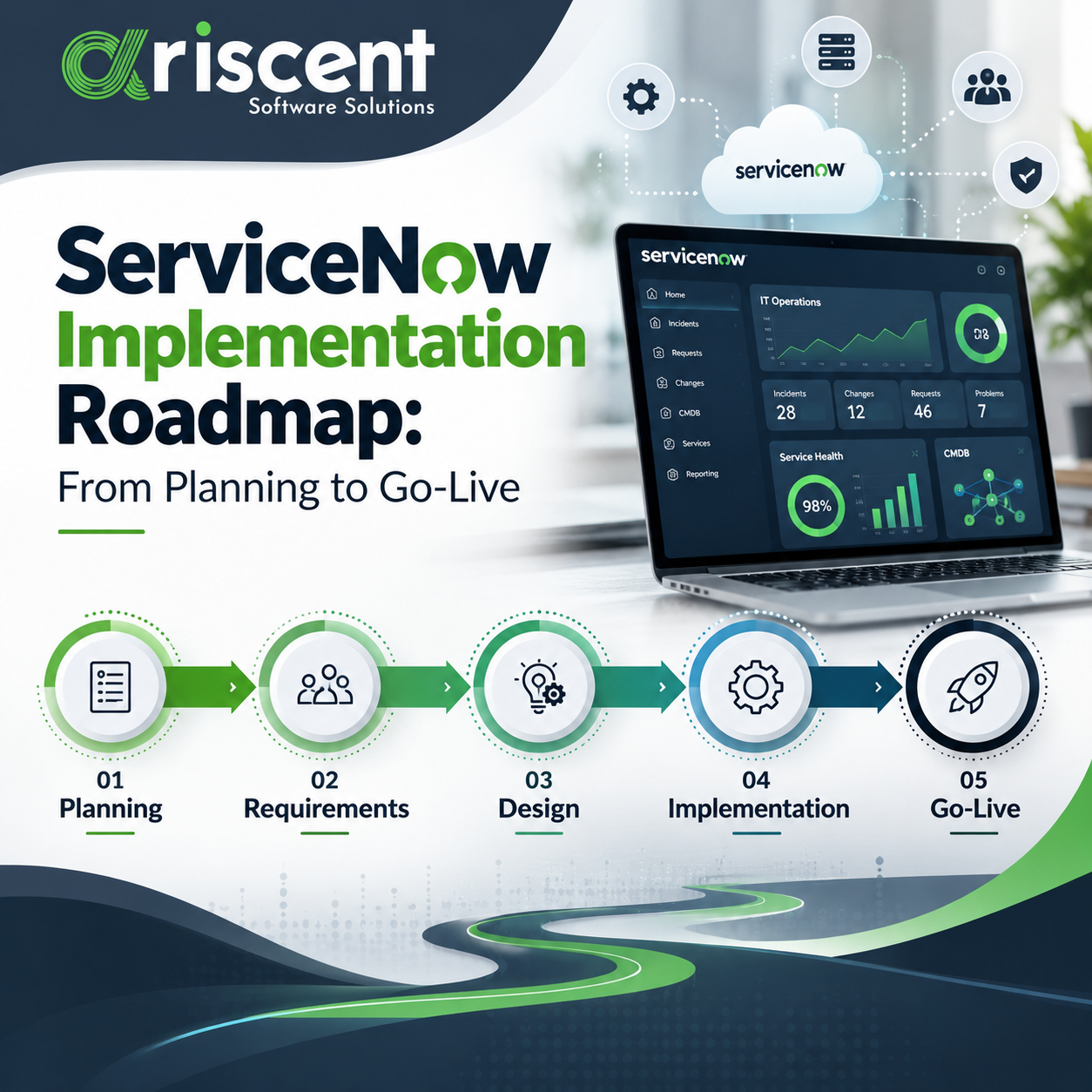
1. What Is ServiceNow Implementation?
ServiceNow Implementation is the process of configuring and deploying the ServiceNow platform to align with an organization’s business and IT requirements. A successful ServiceNow Implementation involves planning workflows, defining requirements, configuring applications, integrating enterprise systems, migrating data, testing functionality, and preparing users for adoption. ServiceNow Implementation Services help organizations implement modules such as ITSM, ITOM, CMDB, Discovery, Service Catalog, HRSD, and other platform capabilities based on their operational needs. A structured ServiceNow Implementation Roadmap provides a clear path from initial planning and solution design through configuration, testing, deployment, and post-go-live support. With proper planning and governance, organizations can establish standardized processes, improve visibility, automate repetitive tasks, and create a scalable ServiceNow environment that can evolve with changing business requirements.
2. Why a Well-Defined ServiceNow Implementation Roadmap Matters
A well-defined ServiceNow Implementation roadmap provides a structured approach for planning, designing, configuring, testing, and deploying the platform. It helps organizations clearly define objectives, business requirements, project scope, timelines, responsibilities, and expected outcomes before implementation begins. A structured ServiceNow Implementation Process also helps reduce configuration issues, avoid unnecessary customization, and improve collaboration between technical teams and business stakeholders. Developing a clear ServiceNow Implementation Strategy allows organizations to prioritize modules, integrations, workflows, data migration, security, and testing requirements based on business needs. It also creates a consistent path from initial planning to deployment and post-go-live support. By following a structured roadmap, organizations can improve project visibility, manage implementation risks, support user adoption, and build a scalable ServiceNow environment that can accommodate future business and technology requirements.
3. Define Business Goals and Implementation Scope
Before starting a ServiceNow Implementation, organizations should clearly define their business goals, operational challenges, and expected outcomes. ServiceNow Implementation Planning begins by identifying which processes need improvement, such as incident management, change management, service requests, CMDB, Discovery, or other IT operations. Teams should establish the implementation scope, priorities, timelines, stakeholders, integrations, data requirements, and success criteria. A clearly defined scope helps prevent unnecessary customization and keeps the project aligned with business objectives. Organizations evaluating ServiceNow Implementation India should also consider their existing IT infrastructure, compliance requirements, user needs, and future scalability. Establishing measurable goals at the beginning provides a foundation for solution design, configuration, testing, deployment, and post-go-live optimization. This structured approach helps ensure that the ServiceNow platform delivers practical value while supporting long-term digital transformation.
4. Gather Requirements and Identify Key Stakeholders
During ServiceNow Implementation, gathering detailed requirements is essential for designing workflows and processes that match business needs. Teams should conduct discussions with IT teams, process owners, administrators, end users, and other relevant stakeholders to understand existing processes, challenges, integrations, reporting requirements, and automation opportunities. ServiceNow Consulting teams can help translate these business requirements into technical and functional specifications while identifying areas where standard ServiceNow capabilities can be used instead of unnecessary customization. Clearly documenting requirements also helps define priorities, dependencies, security needs, and acceptance criteria. As part of the ServiceNow Implementation process, stakeholder involvement should continue through solution design, configuration, testing, training, and go-live. Early collaboration creates shared expectations, reduces requirement gaps, and provides a stronger foundation for successful ServiceNow adoption across the organization.
5. Design the ServiceNow Solution Architecture
During ServiceNow Implementation, designing the solution architecture is an important step for creating a scalable and maintainable platform. The architecture should define how applications, workflows, data, integrations, security, and users will interact within the ServiceNow environment. For ServiceNow ITSM, the architecture may include Incident, Problem, Change, Request, Service Catalog, Knowledge, and SLA management capabilities. ServiceNow ITOM architecture can include Discovery, CMDB, Service Mapping, Event Management, and integrations with infrastructure monitoring tools. Teams should also consider MID Server architecture, integration methods, data flow, role-based access, performance, and future scalability. A well-designed architecture helps reduce unnecessary customization and ensures that ServiceNow capabilities align with business and technical requirements. Proper architectural planning also provides a strong foundation for configuration, testing, deployment, and future platform expansion.
6. Plan ServiceNow ITSM and ITOM Modules
As part of ServiceNow Implementation, organizations should identify and prioritize the ITSM and ITOM modules that align with their operational requirements. ServiceNow ITSM planning may include Incident, Problem, Change, Request, Service Catalog, Knowledge Management, and SLA Management. ITOM planning can cover Discovery, CMDB, Service Mapping, Event Management, and other infrastructure visibility capabilities. The implementation plan should define module dependencies, workflows, integrations, data requirements, roles, timelines, and testing activities. ServiceNow Integration Services can help connect ServiceNow with monitoring platforms, identity systems, cloud environments, and enterprise applications. After deployment, ServiceNow Managed Services can support platform monitoring, administration, enhancements, troubleshooting, and continuous optimization. A phased approach helps organizations manage implementation complexity while creating a scalable foundation for future ServiceNow capabilities.
7. Configure ServiceNow Workflows and Processes
During ServiceNow Implementation, workflows and business processes should be configured according to the organization’s approved requirements and operational objectives. Teams can configure processes for Incident, Problem, Change, Request, Approval, and Service Catalog management while defining appropriate assignments, approvals, notifications, SLAs, and automation rules. ServiceNow Consulting Hyderabad teams can help organizations evaluate existing processes and determine where standard ServiceNow capabilities can replace manual activities or unnecessary customizations. As part of ServiceNow Implementation Hyderabad, workflows should be designed with clear process ownership, roles, conditions, and escalation paths. Proper configuration also includes testing workflows against different business scenarios before deployment. A structured approach helps maintain consistency, improve process visibility, support automation, and create a scalable ServiceNow environment that can be enhanced as business requirements evolve.
8. Integrate ServiceNow with Enterprise Applications
As part of ServiceNow Implementation, integrating the platform with enterprise applications helps organizations connect IT processes, infrastructure data, and business systems through automated data exchange. ServiceNow can integrate with applications such as identity management platforms, monitoring tools, cloud platforms, ERP systems, collaboration tools, and business applications using REST APIs, SOAP APIs, IntegrationHub, MID Server, and other integration methods. ServiceNow ITSM Hyderabad implementations can use integrations to automate incident creation, approvals, user requests, and status updates. Similarly, ServiceNow ITOM Hyderabad implementations can integrate monitoring and infrastructure platforms to bring events, alerts, and configuration data into ServiceNow. Proper integration planning should address authentication, data mapping, error handling, security, monitoring, and scalability to maintain reliable communication between ServiceNow and enterprise systems.
9. Configure CMDB, Discovery, and Data Management
During ServiceNow Implementation, configuring CMDB, Discovery, and data management is essential for creating accurate and reliable infrastructure visibility. The CMDB should be structured with appropriate CI classes, relationships, identification rules, and data governance practices. Discovery can automatically identify servers, applications, databases, network devices, and other infrastructure components and populate relevant CI information in the CMDB. ServiceNow Integration Services Hyderabad can help connect ServiceNow with monitoring tools, cloud platforms, identity systems, and other enterprise applications to improve data collection and synchronization. ServiceNow Managed Services Hyderabad can provide ongoing CMDB administration, Discovery monitoring, data quality management, troubleshooting, and optimization after deployment. Proper data management also includes reconciliation, duplicate prevention, ownership, lifecycle management, and regular CMDB health reviews to maintain trustworthy configuration data.
10. Perform Testing and User Acceptance Testing
During ServiceNow Implementation, thorough testing helps ensure that configured applications, workflows, integrations, and data processes work as expected before deployment. Testing should cover functional requirements, business workflows, integrations, security roles, notifications, approvals, SLAs, CMDB processes, and Discovery activities. Teams should also perform integration and regression testing to identify issues that could affect existing processes. ServiceNow Consulting India teams can support test planning, test case development, defect management, and validation against business requirements. User Acceptance Testing allows business users and process owners to validate the platform using realistic scenarios and confirm that the configured solution meets operational needs. As part of ServiceNow Implementation India, feedback from UAT should be documented, defects resolved, and final acceptance obtained before moving to production and go-live activities.
11. Prepare Users and Administrators for Go-Live
Before ServiceNow Implementation goes live, organizations should prepare end users, administrators, process owners, and support teams for the new platform and processes. Training should cover relevant workflows, roles, navigation, approvals, service requests, incident management, reporting, and support procedures. For ServiceNow ITSM India implementations, users should understand how to create and manage incidents, requests, changes, and other ITSM processes. For ServiceNow ITOM India, administrators and technical teams may require training on Discovery, CMDB, Service Mapping, Event Management, and infrastructure monitoring processes. Training materials, user guides, knowledge articles, and support procedures should be prepared before deployment. A clear communication plan should also explain the go-live timeline, process changes, and support channels. This preparation helps improve user adoption and supports a smoother transition to production.
12. Building a Scalable ServiceNow Environment
A scalable ServiceNow Implementation should be designed to support current business requirements while allowing the platform to expand as organizational needs evolve. Organizations should follow platform governance practices, minimize unnecessary customization, use reusable configurations, and establish clear standards for workflows, data, security, integrations, and application development. ServiceNow Integration Services India can help build reliable connections between ServiceNow and enterprise applications, cloud platforms, monitoring tools, and other business systems. After go-live, ServiceNow Managed Services India can support platform administration, performance monitoring, incident resolution, enhancements, upgrades, and continuous optimization. Scalability also requires regular CMDB health reviews, integration monitoring, access management, and assessment of new ServiceNow capabilities. A well-governed environment helps maintain platform performance, data quality, security, and flexibility while supporting future business growth and technology requirements.